LITE: Liverpool Insect Testing Establishment
LITE helps commercial and academic partners test insecticide-based vector control products against fully characterised susceptible and resistant mosquito colonies.

Welcome to LITE
The Liverpool Insect Testing Establishment, known as LITE, tests insecticide-based vector control products for commercial and academic partners.
We test products against a collection of fully characterised insecticide-susceptible and resistant mosquito colonies.
Established by LSTM’s Vector Biology Department, LITE supports product development from early-stage screening through to post-market performance assessment. We work with partners including the Innovative Vector Control Consortium.
Enquire about working with LITE
What LITE offers
LITE’s laboratories and insectaries are part of the UK Good Laboratory Practice compliance monitoring programme.
Mosquito colonies
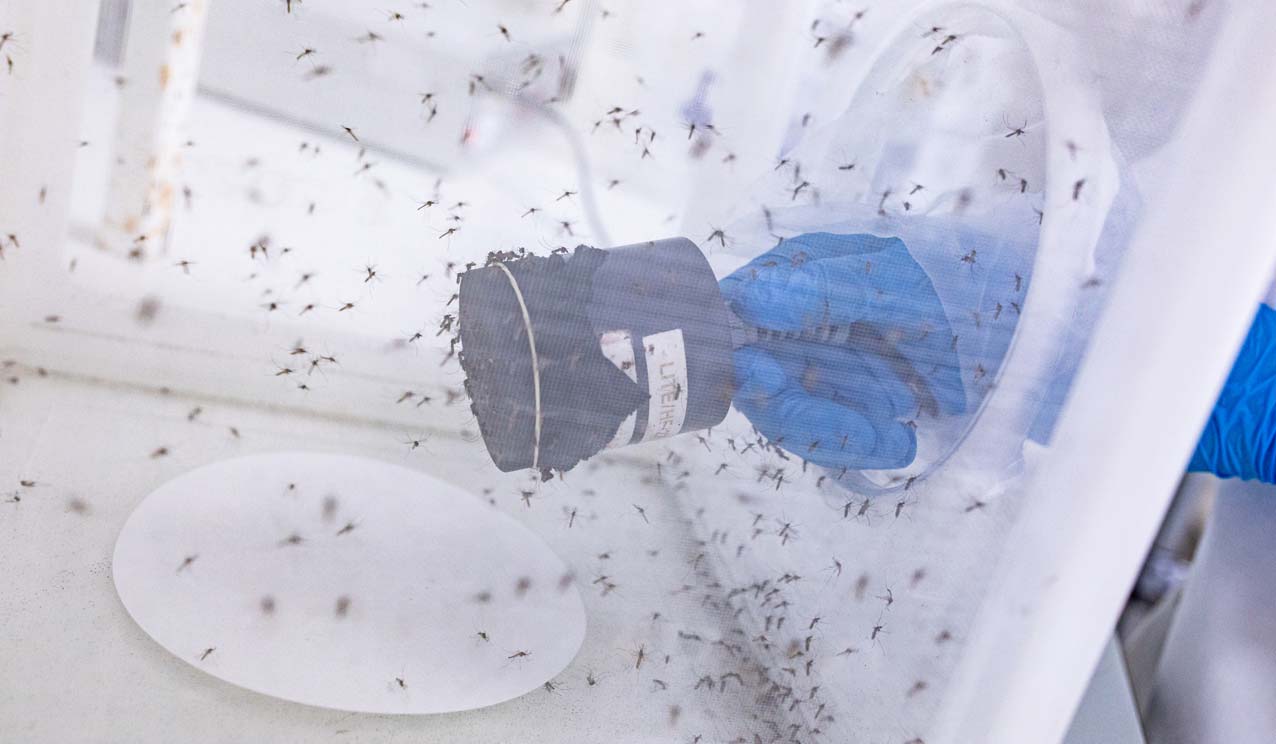
LITE maintains fully characterised insecticide-susceptible and resistant mosquito colonies for on-site testing.
We control environmental conditions within our insectaries, including day length, lighting, temperature and humidity.
All colonies undergo regular quality control. This includes genotyping to verify species identity and monitor the prevalence of known resistance alleles.
We maintain resistant colonies under regular insecticide selection pressure and profile them using discriminating doses to confirm their resistance phenotype.
| Species | Strain | Origin | Phenotype |
|---|---|---|---|
| Anopheles arabiensis | Gaoua-ara | Burkina Faso | Resistant |
| Anopheles gambiae | Kisumu | Kenya | Susceptible |
| Anopheles gambiae | Tiassalé | Côte d’Ivoire | Resistant |
| Anopheles coluzzii | VK7 | Burkina Faso | Resistant |
| Anopheles coluzzii | Tiefora | Burkina Faso | Resistant |
| Anopheles funestus | Fang | Angola | Susceptible |
| Anopheles funestus | FuMoz | Mozambique | Resistant |
| Aedes aegypti | Cayman | Grand Cayman | Resistant |
Additional resistant strains maintained by LSTM’s Vector Biology Department may be available on request.
LITE can also acquire and rear a colony of interest for testing. Subject to material transfer agreements, we may be able to provide mosquito eggs or testing-age adults.
Working with LITE
We work with commercial and academic partners from early product development through to performance assessment, providing access to specialist mosquito colonies, established testing methods and bespoke assay development.
Contact our team to discuss your product, the evidence you need and the most appropriate testing approach.
Enquire about working with LITE