Alumni Seminar: The Policy and Political Economy of Resource Mobilization and Utilization for UHC in Nigeria
- Video
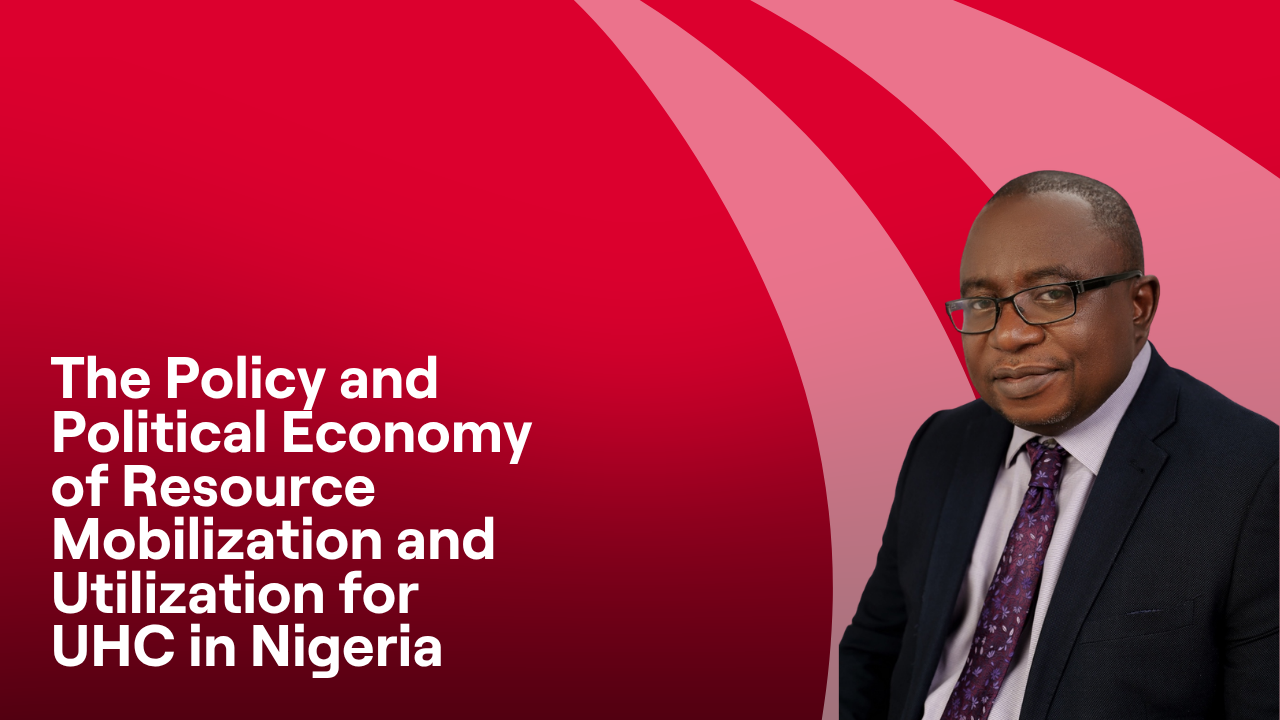
Following a recent Alumni Speaker Event, we were delighted to welcome back Dr Gafar Alawode (MD, MSc, FFPH, FAPH) for an insightful presentation exploring the intersection of politics, policy, and global health.
Drawing on more than two decades of fieldwork and peer-reviewed research, Dr Alawode explored how health financing policy and political economy continue to shape Nigeria’s Universal Health Coverage (UHC) journey.
Event highlights
Health financing is political
Dr Alawode examined how political economy influences decision-making across health systems, affecting the volume, equitable distribution, and utilisation of health resources.
Lessons from the field
The session shared practical insights from senior leadership roles on donor-funded health system strengthening projects across Nigeria, Liberia, and Uganda.
The LSTM connection
Reflecting on his own career journey, Dr Alawode spoke about how his time at LSTM helped shape opportunities to work across global health policy, financing, and systems leadership.
About the speaker
Dr Gafar Alawode is CEO of Development Governance International (DGI) Consult and Chair of the governing council of the National Cancer Intervention Fund.
A globally recognised expert in health systems, he has advised 54 Commonwealth Ministers of Health, served on the World Bank’s health financing resilience core group, and acted as Principal Investigator for major projects funded by the Gates Foundation and AHPSR.
His previous leadership roles include Country Director for Health Policy Plus, Chief of Party for the USAID Health Finance and Governance project, State Team Lead for DFID’s PATHS2 programme, and Country Manager for LATH.
Dr Alawode holds a master’s degree in Tropical Medicine from LSTM, an MD from the University of Ilorin, and has completed executive courses at the Harvard School of Public Health. He is a Fellow of the UK Faculty of Public Health (FFPH) and the Academy of Public Health (FAPH).
[00:00:00] So yes, I’m pleased to welcome Gafar Alawode back to LSTM. It was 2006, wasn’t it? You did MSc Tropical Medicine? Yes, and he’s CEO of D-DGI Consult.
[00:00:13] So he’s advised, , organisations including the World Bank, Gates Foundation, and fifty-four, , Commonwealth ministers as well. And you’re also the national c- the chair of the National Cancer- Intervention Fund … Intervention Fund in Nigeria. There we go. Perfect. , I won’t take much of your time. , Over to you.
[00:00:28] Okay. Thank you very much. Good afternoon good morning, good evening res- depending on where you are you’re joining from. It’s glad to be back to Liverpool two decades after, and from the Lime Street train station there, I couldn’t find my way. Things have really changed. As expected anyway, couple of decades, i’m here to speak with us about probably the journey so far, how LSTM has propelled a career, a journey, and a few thing to share in terms of what we’ve been doing for the couple of decades. Of course, go through this outline quickly. But to quickly show that over the last two decades in terms of how I’ve moved around a bit, and this career is actually propelled by the brand name of LSTM the knowledge base, the social capital of the school and others.
[00:01:17] And I’m happy to tell you that I was actually recruited by the first organisation I worked for aft- during my master’s program. And then of course from there the schistosome liver bushs in tropical health, the consulting arm. I don’t know whether it’s in existence. I worked for that and International Rescue Committee, Global Fund Malaria Project.
[00:01:38] After which is where I did a lot of health system and strengthening job for almost ten years and work on health system policy strengthening environment for Palladium. Before we now decide to look at, okay, all those are lessons that we have learned over time working for many international organisation.
[00:01:57] How do we consolidate that? How do we ensure that we’re able to institutionalize of those lessons learned, especially in the area of health systems, strengthening health financing as well. And then in the process I was asked to chair the Government Council of the National Cancer Intervention Fund, which I agreed to get.
[00:02:15] But this afternoon I’ll be sharing experience and lessons learned regards to the policy and the political economy of health financing reform which I think a student or researcher might find it interesting in terms of, Having deepening our knowledge about the reality of a policy reform to finance our health, especially in the context of complex low and middle income country.
[00:02:38] So just a bit of background about the health indices in Nigeria. Some progress, but of very uneven and we’re still not there. The health system is still the performance still suboptimal in terms of key indices. Of course, you agree with me that in terms of child health indices on progress, but should be one that require more strong stronger health system, maternal and child, maternal health.
[00:03:04] The country is a bit struggling and the society is unequal so the access to healthcare is unequal as well. You can see that the richer you are the better the access. Of course, the policymakers in the country they are worried about this situation and there are a lot of thinking about how do we reform the policy, where would the additional money come from.
[00:03:23] But just to look at before that you look at the f-financing scenario before that in terms of universal health coverage the whole world has made progress, Africa has made progress, also Nigeria. But the progress of Nigeria in terms of universal health coverage, in terms of service coverage index, which is a very important composite index used to monitor health.
[00:03:44] Now-Africa is, lagging behind the global progress and Nigeria is even lag-lagging behind. But even within the Nigeria itself, Nigeria, there are thirty-six state and the federal capital the performance differs in terms of access to healthcare. The more the richer, more urban state tends to have a better access to care.
[00:04:03] But this is not in the spirit of universal coverage. The spirit of universal coverage is that everywhere, irrespective of where you are, you should be able to have access to good healthcare. So this actually, this scenario got the policymaker thinking, and we are looking at where are we going to– What is the cause of this?
[00:04:21] And one of the causes of that is in the financing landscape in terms of the, how health is financed in Nigeria. The government financing is grossly suboptimal in terms of all the indices you can think of, in terms of allocation, in terms of per capita spending and all this. And the country has been looking at where are we going to get additional m-money to finance health, especially to improve access to healthcare by the poor and the vulnerable.
[00:04:48] And that’s led to a number of policy option. One of the policy option is that earmarking or ring-fencing certain amount of money from the government to say, “Okay, this money is dedicated to buying health insur– h-health care package for the poor and vulnerable. And they are looking at a number of options like the sin taxes, health taxes.
[00:05:08] So this is where we are now going in terms of looking at those policy, but at the same time looking at them from the political economy lens as well. So let’s start with the policy and politics of resource mobilization. Let’s look at one of the options that the country is actually looking at is the option around earmarking certain percentage of federal government money, ring-fencing, of course, which has been done by law since two thousand and fourteen.
[00:05:35] But at the same time a number of things happened. This did not just happen by, okay, let’s design it, let’s implement it, and let’s go with it. There are a lot of hindrance. There are a lot of back and forth. There are a lot of situation where there was a pause, where there’s a revision and all this stuff.
[00:05:50] So and that w- that was why we tried to study the political economy of it in terms of what are the interests and influence of actors and institutions, and how do these shape the way the policy evolved. So in terms of the policy itself, the policy ring-fence one percent of the consolidated revenue of the government to be spent in buying health insurance or buying package of care for the poor and the vulnerable, which started, of course es- the legal framework spent ten years in the parliament, the national assembly, and in two thousand and fourteen it was eventually passed.
[00:06:25] But between that then and now, a lot of things happened. A lot of reversal, a lot of changes, a lot of iteration actually happened in, in the process. This underscores the, in the natural process how policy evolve. It’s not pure technical things. This is a political process as well.
[00:06:42] So we decided to study it in my, in my, in our consulting firm. We decided to study the political economy of it in terms of understanding the role of influence of actors and institution, and we use a frame a framework, compass and reach, to actually identify six different type of politics.
[00:06:58] The leadership politics, bu- bureaucratic politics, and others that we are going to see. So these policy actors or these various segment play very important role in shaping how the policy evolve. Like for example, leadership politics. There are thirty-six governors in Nigeria, very powerful- they play a very important role in terms of who’s paying for it.
[00:07:19] The our money should not be deducted. It should be the money of the federal government that is deducted. The lawmaker play very important role. There are a lot of intrigues, 10 years in the parliament that actually change a number of things. So as a result of this intrigues, what’s supposed to be the size of basic health provision fund change, what was supposed to be a combination of spending from the federal and the sub-national level of government.
[00:07:43] So that introduced that change. And in terms of a bureaucratic policy, a number of ministry, department, and agency play a very important role. Constitutionally or by, by law the National Primary Care Development Agency was given the responsibility of designing the the guidelines. But of course, there are other interests as well which actually shape what is the context who is able to access this money from ministry, department and agency.
[00:08:09] In terms of administrative structure for it, a lot of in-in-intrigues. Then a-again, in terms of budget politics what the Ministry of Finance did not actually like it when we want to ring-fence certain amount of money by law, which means that it reduce their flexibility in terms of ability to spend on this or spend on that.
[00:08:28] So they kicked against it at the initial stage. They they were not in support of ring-fencing at it. And then in terms of the external actors’ policies as well donors were actually in favor of this basic health provision fund, but at the same time, they had interest. They want to be part of decision-making.
[00:08:46] So they try as much as possible to ensure that the donors are part of the governing body looking at this. But of course, that did not go down well with some ministry, department, and agency. And then in terms of interest group, a number of interest group, Nigerian Medical Association had interest because there’s a poor access to emergency care.
[00:09:04] So the Medical Association was actually pushing for introduction of the emergency care. But of course the agency responsible for health security said, “Okay, health security is an emergency as well. Let’s share the money.” And of course, that created a lot of tension as well. Then in addition to the basic health provision fund, so the country is actually looking at health taxes taxes on tobacco, alcohol, and sugar-sweetened beverage as well.
[00:09:32] So w-we look at this and try to look at, understand the polit-politics and the policy as well. So one interesting thing that we found out was that of course at the time we did this this study there were those taxes actually e-e-exist. But interestingly, the s-s sector actor called them health tax But the people that designed them did not have health in mind when they were designing this.
[00:09:56] So that affected the volume, that affected the type of policies and attempt to ensure that it conformed with the international standard was met with a lot of resistance because of industry actor was– were not never interested because of when introduced health taxes, it curbs consumption.
[00:10:14] And industry actor want– They don’t want the consumption to be curbed, and that is one of the main objective of the health tax. So we tried to look at this, and we discovered that industry actors play very important role. They even infiltrated the ministry department and agency.
[00:10:29] They try to come up with a lot of argument why there shouldn’t be health taxes as much as possible. But some of our studies findings actually affecting how they are reshaping the health taxes, especially sugar-sweetened beverage, which the parliament is reviewing the legal framework that set it up to ensure that at least the rate conforms with international standard that is potent enough to curb cons-consumption.
[00:10:54] Now, let’s look at some of our recommendation in terms of health tax. We have the opinion that we have to look at the whole policy cycle and ensuring that even the ministry department and agency have adequate knowledge of– about the health taxes, so that they are insulated against influence of the industry actors as much as possible.
[00:11:14] They’re able to use evidence, that they are able to understand the importance of it, and then they were able to build capacity, were able to use data for decision-making as much as possible so that we know what is potent enough. And then when the industry actors are trying to print a counter-narrative, they’re able to understand where they’re coming from as much as possible.
[00:11:37] Then let’s quickly look at the policy and policies of resource utilization. So in terms of financing, there are two aspect of it, mobilizing the resources and using it. So in many low- and middle-income country, and many countries spending on personnel tends to account for huge proportion of spending on, on, on health.
[00:11:57] So that is where we look at in the case of Nigeria, in each of the thirty-six states, they spend h- more than half of spending on health is actually spent on human resources for it. And that is where we look at, okay, how do we how do we best optimize spending on human resources for health?
[00:12:15] So part of the study we look at try to dig into how do we optimize resources with funding from Gates Foundation. We look at ten states in Nigeria, how they are managing, what’s the situation analysis in regards to- Human resources for health, what are they spending– how much are they spending on human resources for health?
[00:12:32] Where is the money going and all this. And then more importantly, what is the opportunity for optimize this– optimizing this funding? You agree with me that perhaps there’s no country that has all the needed health workforce, maybe not even in the UK that have all the needed workforce. But the situation is even very challenging in low- and middle-income country because the fiscal space to be able to recruit additional health workforce isn’t there.
[00:12:56] And they are at the same time battling with challenges of in, a lot of health workers going to the developed world. So I think it may now make sense to look at how do we get the best out of the existing workforce? How do we get the best out of the resources that we’re spending on health?
[00:13:12] So we look at at this using this framework. I try to understand the how to optimize the workforce for universal health coverage, which we actually publish the work. And we identify a number of what we call optimization-enabling practices. What are those practices that help low- and middle-income countries to be able to get the best out of the resources?
[00:13:34] Part of what we look at was the issue of tax shifting and tax sharing, depending on how it is implemented. In some of the states, we’re able to see how– where it was actually implemented, where health workers were able to They are more competent, they’re able to in terms of skill means, they’re able to provide services that were not providing before in terms of shifting these tasks to junior whatever.
[00:13:56] Of course, it comes with all challenges as well. But at the same time, one poi– optimizing enabling policy we came across which was extremely useful was what is called standing order for exit replacement. What does that mean? When health workers leave, whether by virtue of death, moving to another country, retirement, we discover that because of challenges with replacement, so you now discover that okay, health workers have exited the system, but it’s very difficult to replace them.
[00:14:26] And at the same time, for one reason or the other, the fund is still finding the way how. So some of the states were able to put in place what they call standing order to the ministry, some agency that when your health workers leave the system, go and replace them. You have the power to do it.
[00:14:41] And again, in the use of technology, some of the states are introducing biometric attendance tracking technology because absenteeism is a huge problem. The ghost workforce and moonlighting were actually very challenging. Some states were able to introduce biometric attendance technology which they use to, to track as much as possible.
[00:15:02] Then where they p- have necessary institutional arrangement, we have, What we call human resource for a technical working group, where they come together to look at what are the issues, what are the policy. It’s a multi-sectorial. You agree with me that managing workforce is multi-sectorial because you need the Ministry of Finance, you need the Parliament, you need the Planning Commission and all this.
[00:15:20] Where they are doing that, they are able to make a better progress. And again, where they are using data, some states have sophisticated human resource for health information system, which is able to generate information about what is the density of the work, what is the distribution, who is leaving, who is coming in, what is competence.
[00:15:37] There’s a particular state that was able to, after doing the analysis, they now discover that they have more non-clinical or non service provider proportion of the workforce far bigger than those that are providing, seeing the patient. And were able to do what they call a cadre conversion stuff.
[00:15:55] Then again we look at the influence of political economy on the workforce. There are instances where some key policy decision were necessary, but because of the influence of some, of stakeholders it was very difficult. Take for instance the issue of redistribution of workforce. In developing countries tend to have more density of health workforce more in the cities than in the rural area.
[00:16:16] So at times there are plans to redistribute, but of course, because powerful forces will not allow. There, there are instances where this political economy is actually working in favor of taking some decision. There’s a particular state in Kaduna, when the governor was there, there was a need to redistribute, and that was becoming difficult.
[00:16:34] He ensured that he sign off on the dis-distribution plan and that they were able to to do that. Of course, we did look at the issue of remuneration, especially targeting use of resources as a signal to to encourage health workers to go to rural areas, depending on how it is used. I think some tends to get better result in terms of what’s what they call rural posting allowance, where use rural posting allowance to incentivize the health workforce to go to the rural area.
[00:17:01] Then they say the recent development in Nigeria in terms of change in the local local government management arrangement by virtue of our Supreme Court that says, “Oh, there should be autonomy at the lower, lowest tier of government.” We look at the implication for this on the health management in terms of mobilizing resources, in terms of in terms of spending on resources.
[00:17:23] And we discovered that it could on one hand translate to improved governance of health at the, at that level. And then, of course, financial autonomy could mean more money for local government. Local government is res-is responsible for primary healthcare, theoretically more money for PHC as well.
[00:17:40] But because there’s improved political and social accountability that could come with autonomy, we thought that could be a plus in terms of democratizing the health system management. But of course, it come with challenges as well. Challenges of capacity at that level, financial accountability and policy en-environment.
[00:17:58] Just to look at what will change in terms of resource mobilization and utilization in the context of this autonomy for the for local government. Of course, we came up with a number of challenges that we saw and proposition, for example, coordination of primary care at that level could be affected.
[00:18:16] The issue of financial accountability at that level could mean probably weaker management of resources. And then, of course, going to be necessary for us to build capacity of network at that level and then looking at issue of policy alignment. Because there are existing policy that could be disrupted in the context of autonomy.
[00:18:36] But again, probably the one looking at things at more at more global level, looking at what is happening now. So w-we take a look at funding health in the midst of external financing cohort. Looking at position of the US government last year in terms of major disruption into global health financing as a result of the policy decision of the United States.
[00:18:59] And we take a look at what does it mean for most low and middle-income country in terms of the way financing health. Of course, most of the literature you look at, the– everybody’s talking about, “Oh, we have to focus more on fi– sustainable financing, looking inward, domestic financing.” But at the same time, we try as much as possible look at what do we mean?
[00:19:18] What is the possibility of improving domestic financing for health in the context of health courts? One thing that we actually look into is that we have to be very realistic in terms of what is the potential of most of these low, middle-income country to spend more on health.
[00:19:34] I think if a typical low-income country like Sierra Leone with GDP per capita of less than a thousand per capita, and then maximum tax effort around fifteen percent, and if you are able to locate fifteen percent of their tax on health, they can They may not be able to do more than $20 US dollar per person a year.
[00:19:55] So at the best of effort, we have to be realistic. But at the same time, what we are looking at is that those of us in health financing space, we have to look beyond what is available now and look at can we work at the level of fiscal transformation in terms of looking at ability of a country to grow the economy, to spend more on, on health.
[00:20:15] The issue of debt burden because most of the… There are country that are spending more on debt repayments than they are spending on health and education combined. In a forum like this, an international institution at LCM, I think you lend your voice to global conversation around debt to health in terms of probably reducing the debt burden and encouraging low-income country to spend more on health.
[00:20:39] And again, there are on top of a-advantage or opportunity around climate change and health. You tapping into that to financing health as well. Health is a latecomer when it comes to climate financing. Unlike other sector, health is not really really benefiting.
[00:20:54] I think we, we’ll find out about some of these things. So in the co- in the context of Nigeria, there are a couple of opportunities which will have implication for other countries as well. For example, there is a huge macroeconomic reforms that are happening in terms of tax reform, in terms of removal of inefficient subsidy, in terms of a removal of a subsidy on foreign exchange and others, which could be a main opportunity, but we have to be proactive as much as possible.
[00:21:21] I talk about EDI autonomy again. And one major reform that is happening in Nigeria is to reduce the fragmentation. Attempt to reduce fragmentation in external financing. So that’s why sector-wide approach is introduced, which means all donor money, every mon- all the money from government donor and others and private sector is actually aligned towards a common cause.
[00:21:42] Of course, they’re very challenging, but that’s a huge opportunity we want to look at. One other opportunity is the use of technology. I’ve just told you about use of technology for biometric attendance tracking to try to solve the issue of absenteeism, ghost worker, moonlighting and others.
[00:21:57] And of course issue of climate change and health are tapping into those opportunities. So going to my last slide which is the general recommendation based on lessons that we have learned, Nigerian context, global context, in the context of low- and in- income country. I think one of the most important lesson that we’ve learned is we have to think and work politically in de- in designing health policy, especially the policy around financing because, from what we saw, it probably would have shortened the curve if we were actually thinking and working politically in design of basic health provision fund and other reforms.
[00:22:31] So what am I talking about is that reforms are not purely technical things. They are political as well. And again, we have to deploy very participatory approach in, in, financing reform. There are instances where some segment of the society, and that is why we try as much as possible to look at different type of policies that could be in play.
[00:22:53] I think going forward, I think it should be a norm that, you, whenever we are doing policy reform, we have to look at the different policies that could be in place. And again, now we have to try as much as possible to align incentive and leverage policy window as much as possible. One of the policy windows which people have leveraged recently is the issue of a pandemic actually brought into the fore the need to strengthen the health system.
[00:23:17] But at the same time election cycles is a very important policy window to cycle because during the policy– during the election, that’s when the electorate come closer to the to, to the politician. Then I think they need to think through what are the optimization enabling policies.
[00:23:34] Because the truth of the matter is that no country will have all the money needed to s- to, to finance its health. It’s even more challenging thing in developing country. But how do we optimize the system, and especially for human resource for health? Because in many parts of the– of the world, spending on human resources for health account for large proportion, in most cases, more than half of what is spending on health.
[00:23:57] And lastly, I think I w- I would like to appeal to the LSTM audience, especially those that are interested international global health as well. How do we support low- and middle-income country? How do we have to voice towards removing the barriers that makes it difficult for the low- and middle-income country to spend more of their own resources?
[00:24:18] What reforms are we going to support? How do we create a global momentum so that at least we’re able to create more fiscal space to spend on health? On this note, I would like to thank you for for listening, and I’m more than happy to take questions and contributions.
[00:24:37] Has anyone got any questions at all? Now we’ve got about twenty people online, so if anyone online wants to submit a question, please use the Q&A. But In the meantime, has anyone got any, anything in the room? Okay, hi my name’s Lizzie. I’m a master’s student here, but I’m an intercalating medical student, so I’m halfway through my medical degree.
[00:24:54] And I was quite interested in what you talk about human resources and investment in them, and the fact that I know that Nigeria has one of the highest rates of obviously emigration of doctors to the UK, to Canada, wherever they go. And obviously, you spend what, 100 grand training a doctor for them to then leave the system.
[00:25:11] And I remember in the news it all coming out of them trying to put this, bill in place to prevent doctors leaving or, serve five years in Nigeria until you can leave. But I can’t remember the paper I was reading the other week that basically said, half those doctors are still leaving after fifteen years of being in Nigeria, they still are going.
[00:25:27] So I didn’t know what’s happened since ’cause I know it didn’t pass, that bill. I don’t know what’s been done to maybe make those working conditions different or make, I don’t know, the doctors happier that they want to stay. I don’t know what’s happened. Okay. Okay, great. G- good question because the issue of human resources emigration is a huge problem, especially for a country like Nigeria and m- most of our low and m- medium income countries.
[00:25:49] So they, so there, there are a couple of things that, that government is actually doing. So they, there’s a workforce, a policy that try as much as possible to address both the issue of the pull and push factor in terms of how do we create enabling environment for health workers back home.
[00:26:07] I think the policy looking at the issue of welfarism, the issue of salary structure and all those stuff like that. But at the same time, but the bigger picture is that if you look at the remuneration gradient between a developed world and developing country, the truth of the matter is that there are still some that will still leave, you understand?
[00:26:26] I think part of what is being discussed now is that how do we try as much as possible. Because– And at the same time, there are a number of well-established Nigerian professional in the UK and others that are willing to return to N- to Nigeria for various reasons to go and invest as much as possible.
[00:26:41] I think the government is trying to create an enabling environment for them to to go and work a- as much a- as possible. But the fact of the matter is that if you look at in terms of resources there’s so much huge gap between what is available, what’s the government is able to pay, and then what people will be paid if they travel outside the country.
[00:27:04] And then again, part of what the country government is trying to do is that thinking about this reality, how do we produce more so that if we produce more, some leaves, some will stay back. But at the same time so every things are actually, they are actually linked because the ability of government to pay, to spend on health and spend of human resources is linked to the overall economic situation.
[00:27:27] And that is why some people are optimistic that as we are reforming the macrof- economic space ensuring that economy is growing, ensuring that more money in the hand of government curb wastages, we’re able to have more money and spend money on, on, on health. But at the same time optimizing the workforce is going to be very good.
[00:27:43] So it’s a very difficult one. Yeah.
[00:27:49] Thank you. Okay. Thank you. It was very interesting, and i-it-it’s not… and I’m not an expert at all. And my questions are a bit more general about the macroeconomic aspects. And I was thinking about, from what I know, which is nothing, Nigeria is relatively less poor as compared to many other African countries.
[00:28:16] But I was wondering whether in the past decades it has also been affected by the adjustment, structural adjustments plan from, IMF, World Bank. And if yes, how that affected the political economy of health because that’s, those reforms usually push towards a l- low- lower investments from public money into any non-profitable areas.
[00:28:51] And related to that, I was wondering about the GDP percentage data you presented. I naively think that, health, housing, and education should be the top priority for any country, but that’s not the case anywhere in the world. But, so I was wondering how
[00:29:14] money is allocated in terms of GDP percentage. So what gets the biggest slice of the cake, so to speak? Okay. Very good question because these are very fundamental, part of fundamental issues that actually affected health spending. Of course, the structural adjustments of the ’80s which discourage every spending on social investment actually take its toll on health investment a-as well.
[00:29:39] And this is part of why you see Nigerian government spending less than one percent of its GDP on, on, on health. But at the same time, we have to look at the holistic picture. Of, until recently, Nigerian’s government is not able to collect substantial proportion of its, GDP as tax.
[00:29:56] So as recent as a couple of years ago, tax by– tax as a proportion of GDP was less than ten percent. Is, it’s one of the lowest in Africa and all those. So this is part of what the macroeconomic reform is actually looking at, to ensure that Nigerian government is able to collect substantial taxation from the GDP, and not only that, it’s able to spend a sub-substantial proportion.
[00:30:20] So as a policy response to the structural adjustment from World Bank and all those sorts of things, I think that was when the issue of health insurance actually came up in terms of okay, if government is not able to spend a lot of money, okay, can we collect premium from people and try as much as possible put them in the health insurance a sa-safety net?
[00:30:42] But gov– that has its own drawback as well because you cannot ask poor people to pay premium and everything. So I think that affected spending on, on, on health. So in terms of what’s the government spend on every year, everything is needed anyway ’cause everything works together. That tends to be…
[00:31:00] and then a-again, this has– this is driven by the political economy as, as well. So government tends to spend more on infrastructure in terms of road, in terms of heavy infrastructure which interestingly, people are likely to appreciate more. And then when it comes to the election, becomes the election winner than spending on health, unfortunately.
[00:31:22] So I think those are the part of how the bigger picture in terms of macroeconomic dynamic and structural adjustment, how they affect the spending on health. But of course because there’s a huge movement around universal health coverage, health equity, financial protection there is so much pressure on government to spend more on health.
[00:31:43] And there are a lot of initiative, a lot of civil society organisation. We have Nigerian Universal Coverage UHC forum that is actually pushing, that is contributing to a policy discussion to ensure that the Nigerian government are prioritizing financial protection health. I’ve got one question here on live.
[00:32:02] Okay. Dr. Nwabara how did you navigate the transition from being a full-time clinician to policy and health financing? What were the challenges and rewards? Okay. This is a very interesting question. Since when I was in medical school, the interest has always been the health policy space, to work in the health policy space.
[00:32:21] Because I knew from then was that we have more challenges in health policy space. We have- Then probably I could be more useful in the policy space than the, in the clinical space because we have a lot of people in the clinical space already. And again as a clinician, of course, everybody has his own role.
[00:32:41] But at the same time, I thought if we’re able to change things in the policy space, we’re likely to affect life of more people positively. So it’s– it has been driven by that interest of all over. But let me say something quickly in terms of what changed, in terms of navigation that question asked about.
[00:33:00] When I was coming to Liverpool in twenty-twenty, twenty- two thousand and five for my master’s, maybe like many Nigerians in around, the intention was to come and stay back in the UK, write paper and be a clinician here. But all that changed when I came to Liverpool, and I saw many of our lecturer then, like Ofek, who I don’t know that you see here, and others, doing great research work in Africa, and they became known as a result of that.
[00:33:28] Then I had a reflection, “Okay, I’m running away from Africa, and some people are doing great work and making their names there.” I said, “Okay, probably there’s something I can offer in Africa as well.” I think that was a moment of reflection and reflection as well in terms of h- what changed my orientation because, apart from the interest I had in policy my overriding interest then was, okay, let me come to Liverpool, let me write paper, let me sit down let me stay back as a clinician.
[00:33:56] But then coming here, it’s changed everything. LSTM changed e-everything because we had or we still have a lot of lecturers, seasoned lecturer, researchers that did great research work in Africa. And then– And i-interestingly the year we– I graduated two thousand and six, that was when they reintroduced the graduate what do you call it?
[00:34:18] Graduate a visa that when you graduate, you are able to work and everything. Most of my classmates were so excited. I said, “No, I’m not interested. I’m going back to Africa to work.” So LSTM was a very big factor in terms of shaping, my, my career view. Okay. You touched on it a little bit, but specifically, how do you think the upcoming elections in Nigeria will influence the health financing journey to UHC?
[00:34:44] Okay, great. I’m so much interested in that question because in the last election cycle I was part of, advocate of putting universal health coverage on the political front burner ahead of election. And we did a couple of things. Of course, Nigeria is a big place, but we engage at different levels.
[00:35:01] We engage some serious candidates in, for the political parties and try as much as possible to interact with them in terms of what should be their polic- health policy agenda, to, to shape the agenda as much as possible. I remember in Lagos, in Kano, the two biggest states in Nigeria, we engaged the candidate and we presented to them.
[00:35:21] The present governor of Kano was part of our engagement when we presented this to him. Not only that, we interacted with political parties and try as much as possible to to see how we can influence their health agenda. I must say that the ruling party, we engaged with them as well and the, in their party manifesto, part of what we presented to them in terms of prioritizing universal coverage, pan-health insurance coverage was part of their policy.
[00:35:46] So we’re able to influence that, but we want to do more in this next cycle of election. And why we’re, I think we’re in a better position to do that. So there’s a bit of work we are doing for Gates Foundation, which is called e- an exemplar project, where we are looking at the states that have made progress in Nigeria in terms of reducing ma- maternal deaths, child death.
[00:36:06] What did they do differently? Now we have a better understanding in terms of what to do differently, and we want to articulate and collate this and use it to advocate in terms of the policy agenda for the government. So it’s something that we’re so much interested in.
[00:36:24] That’s it. Thank you very much. We’re just almost one o’clock, so bang on time. And I thank you very much. Thank you very much. And I must thank James for inviting me over to make this presentation. And coming to L- LSTM again brings wonderful, nostalgic feelings. Thank you very much.
[00:36:43] Yeah. Thank you. Thank you very much. So James.